





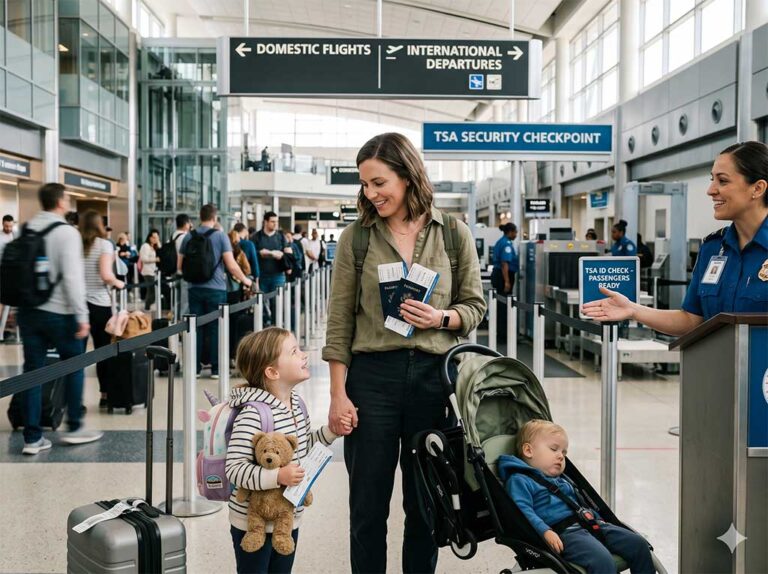
Let’s face it. Flying with kids is kind of challenging and exhausting. Just thinking about how to get the car seat through the airport, making sure your kids don’t bolt during security, making it to the gate with all the baggage and then surviving the flight?
And not to mention, your kid may or may not need some sort of identification to board the plane can be that extra confusion that a new parent just doesn’t need. Well, this article will lay it all out clearly for you and let you know exactly what identification do kids need to fly.
The airport trip might make you nervous, and it’s totally normal to feel that. But you don’t have to worry, you’ve got this. Whether you’re travelling domestically or internationally, if you know what identification do kids need to fly, you avoid having last-minute stress at the airport. And of course, don’t forget to bring baby gear, like a stroller for newborn, to make your trip much easier and far less stressful.
TSA Guidelines: Why Most Minors Don’t Need ID for Domestic Flights
In most cases, the Transportation Security Administration (TSA) and most airlines do not require children under 18 to present a photo ID to get on a plane when they’re boarding with their parents. This means your child does not need identification to fly on domestic flights within the United States. Here is the guidance provided by the TSA:
“TSA does not require children under 18 to provide identification when travelling with a companion within the United States. The companion will need acceptable identification.”
This policy exists because, obviously, minors usually don’t have official photo IDs. Aside from this, the TSA prioritizes safety screening over identity verification for children. As long as you, the accompanying adult, have a valid ID, and your child matches the airline reservation, TSA will allow your child through security.
Just make sure you are eligible, and you have your child’s birth certificate as well as other necessary documents. While TSA doesn’t require kids to have ID, it is better to carry a copy of your child’s birth certificate for backup. And, don’t forget to keep them in quickly accessible places. There’s nothing worse than scrabbling for your passport or immigration documents as the line forms behind you.
Flying with Infants: Required Proof of Age for Lap Children
Airlines require proof of age when you’re flying with an infant as a lap child. Yes, they need to verify your baby’s age, even though TSA does not require identification for most minors. To qualify as a lap infant, your baby must be under 2 years old on the date of travel, and airlines may ask you to verify this at check-in or at the gate.
Acceptable proof of age usually includes:
- Birth certificate (original or copy)
- Passport
- Other official documents showing your child’s date of birth
- Hospital birth records (accepted by some airlines, but policies may vary)
This requirement helps airlines carry out safety regulations and seating rules for lap children. If you’re unable to prove the age of your baby, the airline may require to purchase a separate seat for your child, yes, even at the last minute. So, to avoid delays, you should carry at least one form of age verification when you’re flying with your baby, even on domestic routes.
International Travel: Passport and Visa Requirements for Children
It is a totally different scenario when it comes to travelling in other countries. Children of all ages, including infants, must have a valid passport to enter most countries. Unlike in domestic flights, you cannot just present a birth certificate alone for your child for international travel. Each country has its own entry requirements, so you should carefully review your destination’s rules well before your trip.
Aside from a passport, some countries require minors to have a visa, even if they’re travelling with you. The requirements for a visa can vary depending on your child’s nationality, the purpose of travel, and the duration of your stay. You should apply for visas early, as processing times can be lengthy.
Tips to have a smooth international travel with your kids:
- Make sure your child’s passport is valid for at least six months beyond your planned return date.
- Check visa requirements for your destination country.
- Carry supporting documents like birth certificates
- Make copies of all documents and store them separately from the originals in case of loss or theft.
Necessary Documentation for Unaccompanied Minors Traveling Alone
In case your child is travelling alone, know that airlines have very strict rules to guarantee their safety. Though the age ranges vary by airline, most carriers classify children between 5 and 17 years old as unaccompanied minors. You must provide the proper documentation before the flight to avoid delays or denied boarding.
Required documents usually include:
- Unaccompanied Minor Form: This form should be completed and signed by the parent or guardian. It includes the child’s flight information, contact details of the parents or guardian, and emergency contacts.
- Valid Photo ID for the Child: Depending on age and airline policy, this may include a passport or other government-issued ID.
- Proof of Age: Birth certificate or passport to the child’s age, if necessary.
- Parental Consent Letter: Especially if only one parent is travelling or if the child is travelling internationally.
- Travel Itinerary and Boarding Pass: Some airlines require a printed copy provided by the parent.
- Emergency Contact Information: Up-to-date contact details for the person dropping off and picking up the child.
Just remember to check your airline’s unaccompanied minor policies in advance, as requirements can be different. Also, it is much better if your child arrives early at the airport to give the staff more time to review all documents. And confirm whether the airline provides escort services for international flights.
Traveling with One Parent: The Importance of Notarized Consent Letters
When your child is travelling with only one parent, most countries require a notarized consent letter from the non-travelling parent. This document serves as a confirmation that both parents or legal guardians are aware of and approve of the child’s travel. This letter helps prevent potential legal issues, child abduction concerns, and delays at immigration checkpoints, as well.
A notarized consent letter should include the following:
- Child’s full name and date of birth
- Travel dates, destinations, and flight numbers
- Name and contact information of the accompanying parent or guardian
- Name and contact information of the non-travelling parent(s) giving consent
- Signature of the non-travelling parent(s), notarized by a licensed notary
It is best to always carry the original notarized letters, not just copies. There are also some countries that may require translated versions of the letter. Check with the airline and destination country well in advance for specific requirements. You can also include additional documents, like birth certificates or custody agreements, if applicable.
School IDs and Other Alternative Documents for Domestic Travel
Although minors do not need identification for domestic flights, older children and teens may be asked by airlines for some form of ID, especially if they’re travelling alone. In these cases, alternative documents can serve as proof of identity or age.
Common alternative documents include:
- School ID cards: School IDs are often accepted for older children travelling domestically, especially for unaccompanied minors.
- Library cards or student IDs: Can sometimes be used as supplemental identification.
- State-issued ID cards: Some states issue non-driver ID cards for minors.
- Birth certificate copy: useful if no photo ID is available
Again, it is always important that you check the airline’s policy for acceptable forms of ID before travelling. And bring the original documents, because copies may not always be accepted. Keep all documentation easily accessible during check-in and security screening, as well. And even if ID is not required, it is much safer to bring some form of proof of age. In this way, there’ll be no delays or complications during the trip.
Handling Name Discrepancies Between Boarding Passes and Documents
You don’t want to miss your flight just because there’s a discrepancy between your child’s airline boarding pass and their official identification documents. Even the small differences, like a nickname, middle name, or hyphenated last name, may trigger questions from airline staff or TSA.
Follow these tips to avoid having problems:
- Double-check names when booking: Make sure your child’s name on the reservation exactly matches the birth certificate, passport, or other ID.
- Use full legal names: Don’t use nicknames or shortened versions when entering travel documents.
- Bring supporting documents: If there are minor differences, carry birth certificates, passports, or custody documents to clarify.
- Notify the airline in advance: Some carriers allow you to correct minor name errors before the flight.
- Arrive early at the airport: Extra time helps resolve any discrepancies without missing the flight.
Special Requirements for Newborns and Infants Under Two Weeks Old
You need extra preparation when travelling with newborns, especially those under two weeks old. Airlines and medical professionals often have specific guidelines for very young infants to make they are safe during flights.
Requirements you need to fly with a newborn:
- Medical Clearance: There are airlines that require a note from a doctor confirming the newborn is healthy enough to fly. This is especially common for infants under two weeks old.
- Vaccination and Health Status: Newborns may not yet have received their first round of vaccinations, so it is important to limit exposure to crowds and maintain strict hygiene.
- Proper Identification: Even for newborns, parents should carry a birth certificate or hospital-issued record for age verification if needed.
- Seating Arrangements: Infants under two weeks old usually travel as lap infants. This means they sit on a parent’s lap without a separate seat. Some airlines may require a special restraint device.
- Feeding and comfort: Bring formula, breast milk, or bottles, as well as blankets and pacifiers, to help with feeding and ear pressure during takeoff and landing.
- Monitor Flight Duration: Shorter flights are usually recommended for newborns. Longer flights can increase stress and exposure to germs.
It is best to always consult your pediatrician first before flying with a newborn under two weeks old. Check with your airline for any special policies or requirements, as well.